Optical Trapping and Nanopositioning
Optical Tweezers: Piezo Stages Improve Optical Traps
Parallel-kinematic piezo flexure stages provide high stability, fast response and nanometer-level motion control for optical tweezers and optical trapping experiments.
What Is Optical Trapping?
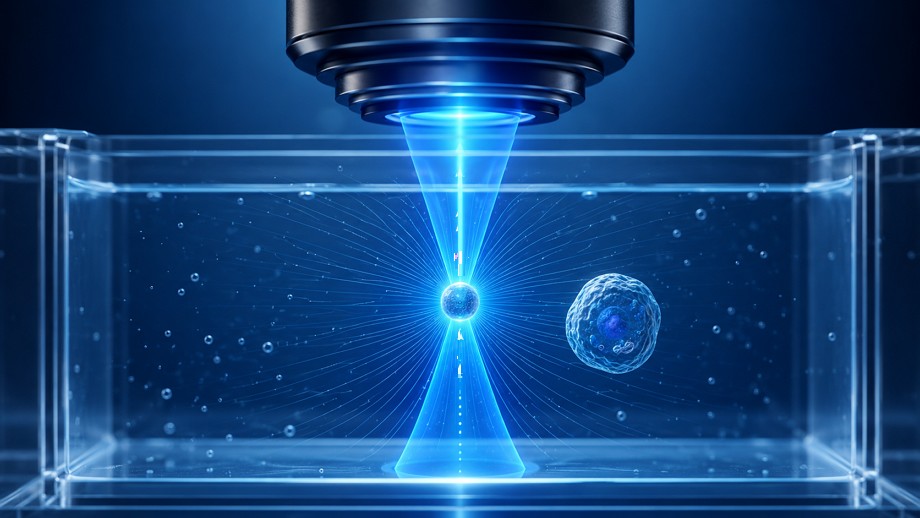
Optical trapping, often called optical tweezing, uses a tightly focused laser beam to hold and move microscopic particles, cells, beads, or biological structures without mechanical contact. The light field creates a gradient force that pulls a small dielectric object toward the beam focus, while radiation pressure pushes it along the beam axis. When these forces are balanced, the object is trapped in three dimensions and can be positioned, stretched, or measured with extremely small forces.
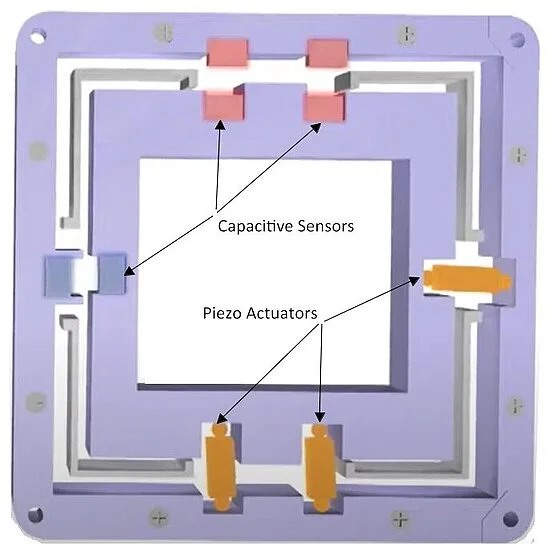
Piezo flexure stages are critical in optical trapping because the trap itself is only as useful as the positioning stability around it. Experiments often require nanometer-scale sample motion, smooth scanning, and fast settling with minimal drift. Flexure-guided piezo stages provide frictionless motion, no stick-slip effects, no backlash, and very high repeatability. Their parallel-kinematic designs can also reduce off-axis errors and maintain better orthogonality during XY or XYZ moves.
In optical tweezers, piezo stages are used to position the sample chamber, scan trapped particles relative to optical structures, calibrate force measurements, and apply controlled displacements to biological molecules or microspheres. High bandwidth is important because force, displacement, and dynamic response are often measured in real time. A stable piezo flexure stage improves measurement quality, reduces noise, and makes optical trapping experiments more repeatable.
When Was Optical Trapping Invented?
The foundations of optical trapping were developed in the 1970s through pioneering work on radiation pressure and laser manipulation of small particles. In 1986, Arthur Ashkin and colleagues demonstrated the single-beam gradient-force optical trap, now widely known as optical tweezers. This made it possible to hold dielectric particles near the focus of one strongly focused laser beam and manipulate them with extremely small forces.
Optical tweezers became especially important in biology and biophysics because they allow researchers to handle micron-scale objects, cells, beads and molecular systems without mechanical contact. The technique later became a standard tool for measuring small forces, studying molecular motors, stretching biomolecules, and positioning particles in microfluidic and microscopy experiments.